Sustainability · Surfboards
Is surfing sustainable? The green paradox of the surfboard
Surfing sells itself as the most natural sport there is. The numbers say something else: the boards are made from oil, most of the damage is done before anyone paddles out, and surfers themselves admit the contradiction.
Short answer: not as much as its image suggests. A standard surfboard is a petrochemical product: a polyurethane or polystyrene foam core wrapped in fibreglass and polyester or epoxy resin. Research from UC Berkeley found that the foam blank and the resin account for about 70% of a board’s carbon footprint. The same research found that driving and flying to the waves make up almost all of a surfer’s total footprint. Surfing’s green image rests on the ocean, not on how the sport is equipped or consumed.
The image and the data
Few sports are sold on nature the way surfing is. Clean water, empty lineups, beach clean-ups, a board under your arm. Surfers are often among the first to speak up for the coast, and that commitment is real.
But when researchers looked at what surfers actually do, the picture split in two. A 2021 study of Norwegian surfers published in Frontiers in Sports and Active Living found that 84% described themselves as environmentally conscious. In the same group:
- 58% bought a new surfboard every one or two years;
- about two-thirds took one or two international surf trips a year by plane;
- only 23% said they actively tried to fly less.
The authors call this cultural dissonance: surf culture celebrates nature and, at the same time, celebrates the constant search for new boards and faraway waves. Both values sit side by side, and the second one usually wins.
What a standard surfboard is made of
Most boards sold today follow one of two recipes.
PU / polyester
A polyurethane foam blank, shaped by hand or machine, glassed with fibreglass and polyester resin. The classic “poly” board.
EPS / epoxy
An expanded polystyrene core glassed with fibreglass and epoxy resin. Lighter and tougher, and often sold as the more modern option.
Both are made almost entirely from fossil-based materials. The Surfboard Cradle-to-Grave study by Tobias Schultz at UC Berkeley found that the foam blank and the resin make up about 70% of a board’s carbon footprint, while the fibreglass is less than 5%. In other words, the core is where the problem sits.
Two other facts rarely make it into the marketing:
- Waste. A lifecycle study by Sustainable Surf found that wasted foam and resin, the offcuts, dust and excess left in the shaping bay, account for about 40% of the carbon footprint of a standard poly board.
- Workshop air. Polyester resin releases styrene while it cures, and polyurethane foam is made from isocyanates. The same Sustainable Surf study recorded a significant drop in carcinogenic emissions during glassing when epoxy resin was used instead of polyester.
And when a foam board snaps or delaminates, there is very little to do with it. Glass-reinforced resin is a thermoset: it cannot be melted down and reused like an ordinary plastic.
The day the foam ran out
In December 2005, Clark Foam closed without warning. The Californian company made the majority of the polyurethane blanks used by surfboard shapers worldwide. Its owner cited difficulties with environmental and safety regulators over the chemicals it used, including toluene diisocyanate (TDI). Within weeks, shapers were scrambling for blanks.
The episode showed two things at once. First, how much of a “handmade” industry depended on a single chemical supplier. Second, how quickly an industry built on oil can be thrown into crisis by the rules that govern those chemicals. New blank makers appeared in the US and Australia, and EPS and epoxy spread. The core stayed a foam.
What “eco” boards fix, and what they don’t
The industry has responded. The best-known effort is Sustainable Surf’s ECOBOARD label, which asks builders to use lower-impact resins and cores, such as bio-based epoxy and recycled EPS. Its lifecycle study found about 30% lower carbon footprint for a board built with bio-epoxy and a blank with 25% recycled content, and cut the share of footprint lost to waste from about 40% to 22%.
That is real progress, and we would rather see an ECOBOARD than a standard board in the water. But it is worth being clear about its limits:
- the core is still a petrochemical foam;
- the board is still a resin-and-glass shell that cannot be recycled;
- it does nothing about how often boards are replaced, which is the habit the Norwegian study describes.
A cleaner board bought every year is still a board bought every year.
Wood and hollow boards: what really changes
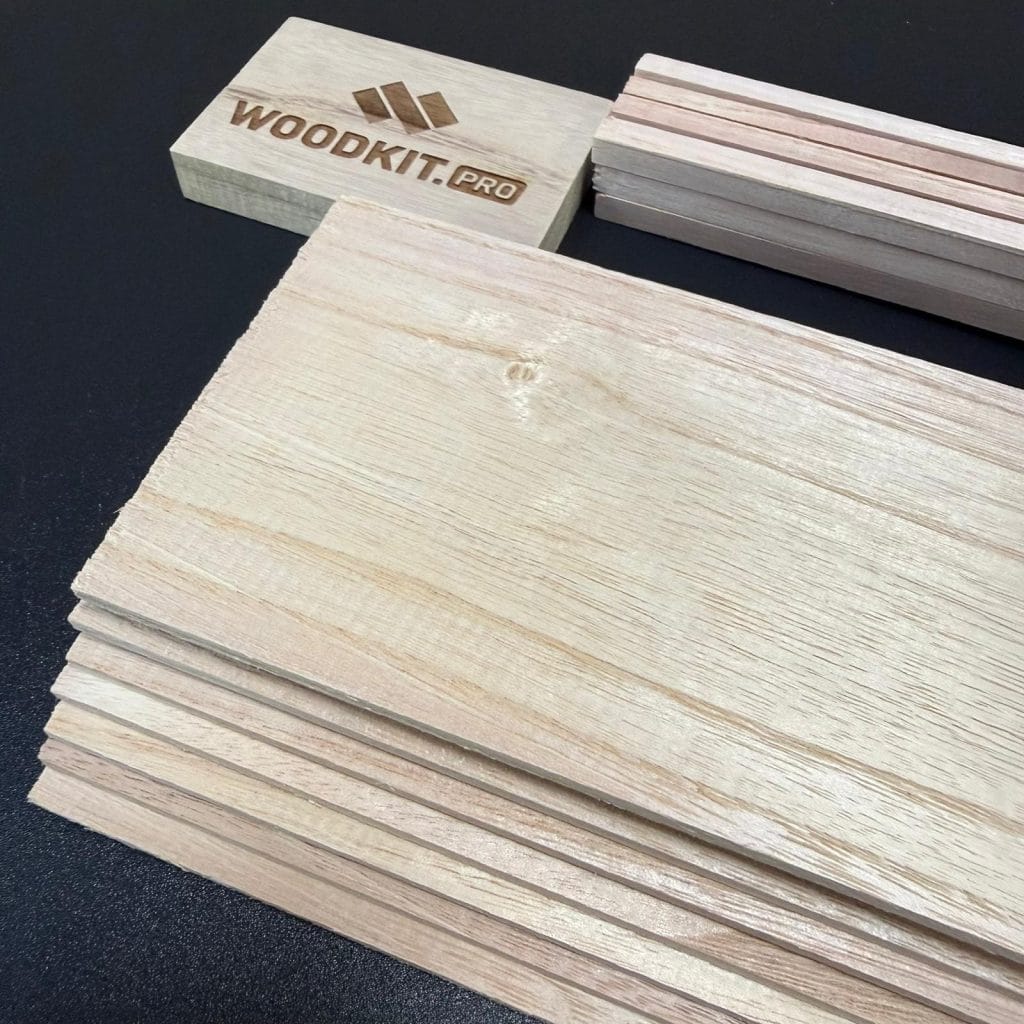
A hollow wooden surfboard takes a different route. Instead of a foam core, it has an internal frame, thin wooden skins for the deck and bottom, and wooden rails. The wood we use is Paulownia, one of the lightest timbers you can build a board from.
What changes:
- The core stops being foam. The part of the board that the Berkeley study linked to most of the footprint is replaced by timber grown in plantations.
- The board is built to be kept. Damage to a wooden shell can be repaired like any other piece of woodwork. It is a board you keep for years, not one you replace each season.
- Less waste in the build. When the frame and panels are cut to measure, there is no big blank to carve down and throw away.
- You know what it is made of. Especially if you build it yourself.
What doesn’t change, and we say it plainly: a hollow wooden board is still sealed in epoxy resin and fibreglass. It has to be, because unprotected Paulownia is soft and not durable. It is also usually somewhat heavier than a foam board of the same size. A wooden board is not a zero-impact object. It is a board with a different core, built to last, and that is where the difference comes from.
We are not going to put a carbon number on our boards until there is a proper study behind it. Too much of the surf industry’s green talk rests on figures nobody can trace.
What you can do
You don’t need to give up surfing to surf with a lighter conscience. The research points to a few changes that matter more than any label:
- Buy fewer boards and keep them longer. A good board repaired three times is better than three new ones.
- Repair, don’t replace. Fix dings early, before water gets in.
- Choose the core, not just the label. Ask what is inside the board, not only what resin was used on the outside.
- Surf closer to home. Travel is the largest part of a surfer’s footprint. One flight fewer a year does more than any material choice.
- Build your own. A board you have built yourself is a board you will look after. See how a hollow wooden board is built.
FAQ
Is surfing bad for the environment?
Surfing itself is low-impact, but the way it is equipped and consumed is not. Standard boards are made from petrochemical foam and resin, and research shows that driving and flying to surf make up most of a surfer’s carbon footprint.
What is the most sustainable surfboard?
There is no zero-impact board. The biggest gains come from a core that is not petrochemical foam, lower-impact resins, a board that can be repaired, and above all keeping the same board for many years.
Can foam surfboards be recycled?
Very rarely. The foam is wrapped in glass-reinforced resin, a thermoset that cannot be melted and reused. A few projects recover EPS offcuts from workshops, but most broken boards end up in landfill.
Are wooden surfboards more sustainable?
A hollow wooden board replaces the foam core, the part linked to most of a board’s footprint, with plantation-grown timber, and it is built to be repaired and kept. It is still sealed in epoxy and fibreglass, so it is not impact-free.
What is an ECOBOARD?
A label run by Sustainable Surf for boards built with lower-impact materials, such as bio-based resin and recycled foam. Its lifecycle study found about 30% lower carbon footprint than a standard polyurethane and polyester board.
Keep reading
Guide
Paulownia wood for surfboards: the builder’s guide
Density, stability and durability with lab data, and a real cut list for a hollow board.
Read →The tree
What is Paulownia? The tree, the wood and what’s true about it
Botany, uses from Japan to surfboards, main properties, and the myths that don’t hold up.
Read →Surf industry
How surfboards are made today: the industry behind the board
Factories in Asia, supermarket foam boards, CNC shaping and famous logos that no longer make anything.
Read →Build local
Build local: a different economy for surfboards
The design travels, the board is built near the wave. Where the idea comes from and where it falls short.
Read →A board you keep, built by you
Pick a shape and get the frame cut and the Paulownia prepared for every part. No foam core, no blank to throw away.
Sources
- Langseth T., Vyff A. (2021). Cultural dissonance: surfers’ environmental attitudes and actions. Frontiers in Sports and Active Living 3: 695048. frontiersin.org.
- Schultz T. C. (2010). The Surfboard Cradle-to-Grave Project. Surfrider Foundation / UC Berkeley. See also Think globally, surf locally, Berkeley Engineering.
- Sustainable Surf / Pure Strategies. The ECOBOARD Lifecycle Study.
- CompositesWorld. Waves of change: from shock to opportunity (Clark Foam closure).
- Clark Foam, Wikipedia.